Thursday, April 5, 2007

Monday, April 2, 2007
EDUCATION IN CHINA
 Education in China is normally divided into three stages, primary, secondary and tertiary education. Primary school is the first and essential level education for any eligible child. There are two stages in the secondary education---Middle School and High School. In generally, tertiary education is any education after completing general high school. This includes universities and all kinds of colleges.
School is compulsory from the ages of six to fourteen, which means children should get education from year 1 till the end of the Middle School. Students who want to continue studying in universities should complete High School’s education. But if not, the students can choose some Vocational High Schools to study after Middle School. Tertiary education is not compulsory, but most of Chinese parents hope their children can get degrees as high as possible, because many Chinese people believe that--- the higher education, the better life in the future.
Primary education
In China, children go to Primary School when they are six years old. From Year1 to Year 6, they have to study Chinese, English, Mathematics, History, Geography, Music, Drawing and Sports. Students have different teachers to teach their different subjects. There is lots of homework for students even in Primary School.
Secondary education (includes 3-year Middle School, 3-year High School)
Children start Middle School when they are twelve years old. There are two stages in here, each stage is three years, a total of six years. First three years is called Middle School, and the second three years is called High School. Students should have to complete three years education in the Middle School. So from Year 1 in Primary School till the end of Year Three in the Middle School, children have “Nine Years Education” on duty, which is free and compulsory education supported by the Chinese government.
After that, students usually have two choices. One is— to continue studying in High School. After that they try to get the qualification to enter into the university. Students have to get a good enough score from a very important exam which is hold by Chinese Education Department every year. The other choice is ---to study in Vocational High School. Students can study some vocational courses for their future career in these vocational schools.
Tertiary Education
There are lots of colleges and universities within in China. There are many subjects and majors you can choose to study. Such as Economics, Computing, Business, Medicine, Finance, History, Arts, etc. The tuition is very different from different colleges or universities. But no doubt, it has been became higher in the recent years.
Nowadays, more and more Chinese parents send their children to study overseas. Some English language countries are very popular for them, such as, U.S.A., UK, Australia and Canada.
Wednesday, March 28, 2007
The Rocks
 When you visit the Sydney, one of the most attractive places you shouldn't miss it--The Rocks! The Rocks is famouse for its histrical value because this is the first European settlement. The oldest buliding--Cadman's Cottage in Sydney and the oldest street--Geroge Street in Australia, some interesting museums, etc. all of amazing buildings and places in the Rocks.
Earth Hour
 Earth Hour is a very good activity which calls for people to switch off any electrical things, such as, lights, TV, computer, etc. during 7:30pm to 8:30pm on March 31 (Saturday). This action aims to reduce greenhouse effection in Sydney, but also hope more and more relize that they can do something easily and protect our enviroment.
 I supposed that's a very good idea. I am going to join this action during the special time mentioned. Now more and more people are ware of our enviorment are getting worse and worse due to our human being so greed behaviors. Everyone who lives on the earth should have responsibility to protect our earth villege, we can do some little things from our daily life, such as, instead of driving car, we can try to take the public transportation; try to not use plastic bags as much as possible; save water-take a shorter shower, fix your leaking taps, etc.
 Well, we learn a sentence from Marion--Prevention is better than the cure. Maybe some people watched the Hollywood movie--The Day After Tomorrow, in fact, the things would be happened possible if the Global Warming has been continuting. So everybody should do something about stopping Global Warming, Greenhouse effection, etc. from now on from any little or small or simple thing.
Wednesday, March 14, 2007
Library

*Vocabulary
--Catalogue: List of all the books in the library
--Borrow: To take a book home for a short period of time and return it later
--Item: Books/video tapes/cassettes/CDs
--Renew: To extend the borrowing time
--Chute: Box where you can leave the books after hours (when the library is closed)
--Overdue: It had to be returned, but you haven't done it yet
--fine: Money you have to pay if returning a book late
--CD-ROM: Disk with sound, images and text
*Questions
1. Who can borrow from the TAFE library?
-Every student who enrolled study in TAFE hold a TAFE CARD.
2. What do you need to bring to join in?
-The TAFE card
3.How many items (things: books, videos, etc) can you borrow?
-10 items, including 6 print items(books, magines, etc.), 4 item vedio items.
4.What is included in print items?
-Books, Magazines, etc.
5. How long can you borrow books for?
-2 weeks
6.How long can you borrow videos for?
-1 weeks
7.What happens if you want them for a longer time?
-renew your borrowed items.
8.How can you renew books or other library items?
-Ring the phone
9.How many times can you renew items?
- Twice
11.Can you search the library catalogue from home?
- Yes,I can.
12. Can you return books after-hours?
- Yes, I can put the books into the chute.
13.When is the library open?
- 8am-9pm
14.How can you make photocopies or print from one of the library computers?
- Put some money into my TAFE card firstly.
15.How much does it cost?
- Normally it costs 20 cents for each A4 paper.
16.Is it the same price for Student Association members?
- No, it is not the same price for SA members. It's just half price-10 cents for each A4 paper copy for SA members.
17. What other services are provided?
- Help student's assignments, help finding information, etc.
18. What ESL resources do they have?
- There are lots of ESL resources in ST. GEORGE TAFE LIBRARY, such as books, exercise books, audio tapes, dictionaries, story books, etc.
19. Can you borrow books from other TAFE libraries?
-Yes, I can.
20. What is a good idea for ESL students?
- If a student who wants to buy a good ENGLISH TO ENGLISH DICTIONARY, it's a good idea for him or her to borrow one to read it first.
--Catalogue: List of all the books in the library
--Borrow: To take a book home for a short period of time and return it later
--Item: Books/video tapes/cassettes/CDs
--Renew: To extend the borrowing time
--Chute: Box where you can leave the books after hours (when the library is closed)
--Overdue: It had to be returned, but you haven't done it yet
--fine: Money you have to pay if returning a book late
--CD-ROM: Disk with sound, images and text
*Questions
1. Who can borrow from the TAFE library?
-Every student who enrolled study in TAFE hold a TAFE CARD.
2. What do you need to bring to join in?
-The TAFE card
3.How many items (things: books, videos, etc) can you borrow?
-10 items, including 6 print items(books, magines, etc.), 4 item vedio items.
4.What is included in print items?
-Books, Magazines, etc.
5. How long can you borrow books for?
-2 weeks
6.How long can you borrow videos for?
-1 weeks
7.What happens if you want them for a longer time?
-renew your borrowed items.
8.How can you renew books or other library items?
-Ring the phone
9.How many times can you renew items?
- Twice
11.Can you search the library catalogue from home?
- Yes,I can.
12. Can you return books after-hours?
- Yes, I can put the books into the chute.
13.When is the library open?
- 8am-9pm
14.How can you make photocopies or print from one of the library computers?
- Put some money into my TAFE card firstly.
15.How much does it cost?
- Normally it costs 20 cents for each A4 paper.
16.Is it the same price for Student Association members?
- No, it is not the same price for SA members. It's just half price-10 cents for each A4 paper copy for SA members.
17. What other services are provided?
- Help student's assignments, help finding information, etc.
18. What ESL resources do they have?
- There are lots of ESL resources in ST. GEORGE TAFE LIBRARY, such as books, exercise books, audio tapes, dictionaries, story books, etc.
19. Can you borrow books from other TAFE libraries?
-Yes, I can.
20. What is a good idea for ESL students?
- If a student who wants to buy a good ENGLISH TO ENGLISH DICTIONARY, it's a good idea for him or her to borrow one to read it first.
Wednesday, February 28, 2007
Safety at the Beach
---Do you know all the signs?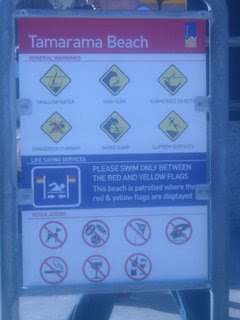 If not,
Which ones are new to you?
---Do we have all these signs in Sydney?
---Do they have all these signs in your country of origin?
 If not,
Which ones are new to you?
Before today, I didn't pay more attention to these signs when I was at the Beach. That's good and important to understand them for our safety at the beach since now.
---Do we have all these signs in Sydney?
yes, I think that we have all these signs in Sydney.
---Do they have all these signs in your country of origin?
No, I don't think all these signs in my country. Some of smiliar signs are in my country, but some of them are not.
(The phote is from Rosa's blog)
About flower

Hi, Marion!
That's a very beautiful picture! I have never seen this kind of flower in my life before today. I supposed that this photo is about a flower of banana. And maybe it was took in your home's garden?
That's a very beautiful picture! I have never seen this kind of flower in my life before today. I supposed that this photo is about a flower of banana. And maybe it was took in your home's garden?
Subscribe to:
Posts (Atom)